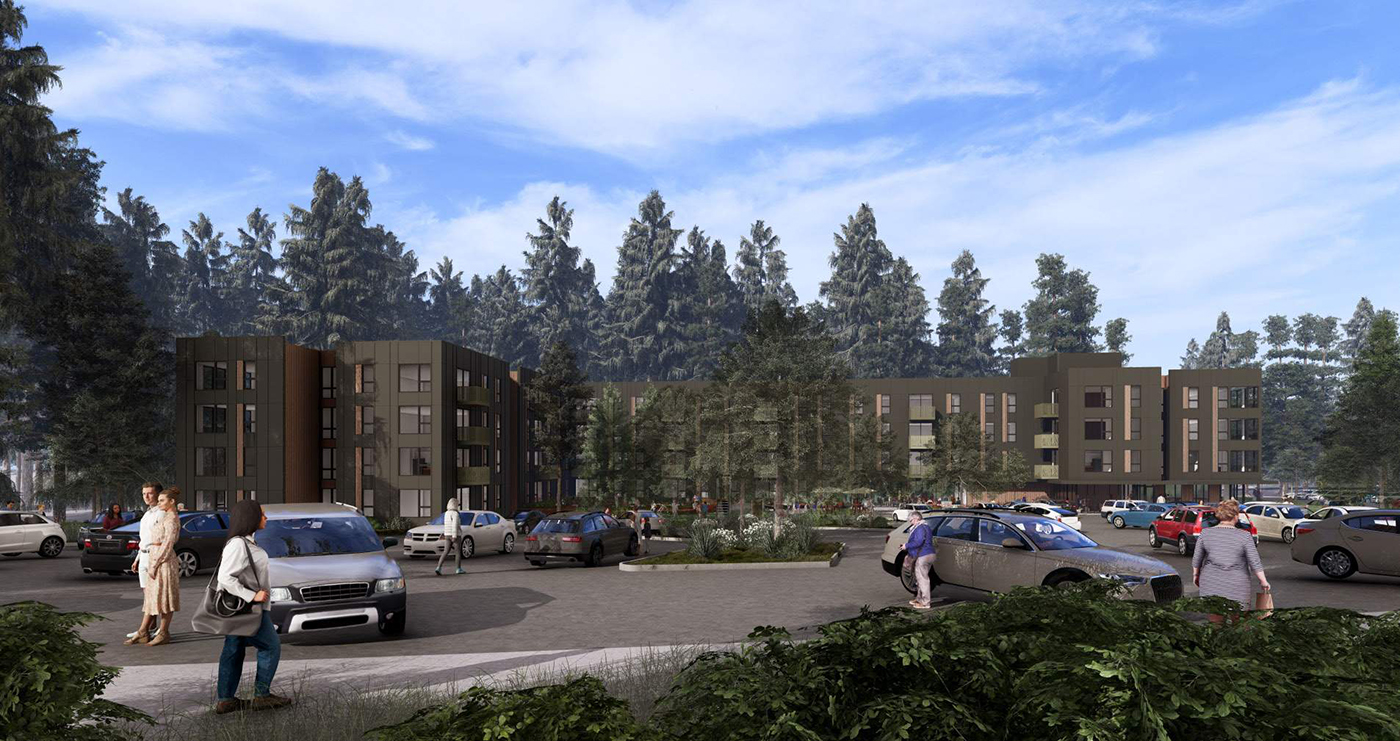
Architect's rendering of the planned Forest Edge development at Saint Andrew's Lutheran Church in Bellevue, which will deliver about 100 affordable homes. (
Imagine Housing
)
Hundreds of acres of faith-owned land sit ready for affordable housing on Seattle's Eastside. Until recently, the rules made building nearly impossible.
In 2024, HR&A Advisors partnered with Imagine Housing, a nonprofit affordable housing developer and advocate serving the Eastside, to find out why. Using HousingWeaver, the team mapped every faith-owned parcel across the region, modeled development potential, and identified barriers blocking progress. That research helped inform House Bill 1859, a new state law that removes key regulatory and financial obstacles to faith-based development.
The findings, and what came next, tell a clear story:
- The Eastside is facing a shortage of over 16,000 affordable rental homes, with rents up 61% since 2015.
- HR&A's parcel analysis identified over 200 faith-owned sites across the Eastside eligible for density bonuses, with potential to produce between 5,500 and 9,000 new affordable homes, roughly doubling the region's current stock.
- Financing rules required 100% affordability to qualify for a density bonus, locking projects into scarce LIHTC subsidies. HB 1859 adopted HR&A's recommendation to allow mixed-income development, broadening the threshold to 50% of units at 80% AMI or 20% of units at 50% AMI.
- Where eligibility is broad, mixed-income development is permitted, and faith communities have dedicated support, the potential for affordable housing on faith-based land is significant.
A Severe Housing Shortage and an Untapped Opportunity
The Eastside's housing crisis is not an abstraction. As of 2024, more than 16,000 rental homes were missing for households earning less than $75,000 per year.
Rents have climbed 61% since 2015, and over 91% of households earning between $35,000 and $50,000 are cost burdened. Without meaningful new supply, that pressure will keep moving up the income ladder.
Using HousingWeaver's parcel analysis tool, HR&A set out to assess how much of the solution to the Eastside's housing crisis might already exist on faith-owned land. The analysis began with Bellevue, the first Eastside city to implement a density bonus for affordable housing on faith-owned land. Bellevue's C-1 overlay designated eligible parcels based on proximity to multifamily zones, arterial streets, and frequent transit.
How Bellevue's C-1 overlay filters faith-owned parcels
Four filters narrow Bellevue's roughly 72 faith-owned parcels to 36 that qualify for the C-1 density bonus: parcels must sit outside single-family districts, within a quarter mile of frequent transit, and within 500 feet of multifamily or commercial uses.
Of Bellevue's roughly 72 religiously owned parcels, 36 qualified, opening new development capacity in neighborhoods previously restricted to single-family homes.
HR&A then modeled what would happen if Bellevue's approach were applied region-wide. The results were striking: over 200 sites would become eligible for density bonuses, with the potential to produce between 5,500 and 9,000 new affordable homes, roughly doubling the region's current deed-restricted stock of approximately 9,035 units. But Bellevue's criteria, designed for a denser, transit-rich city, left most of the Eastside behind. In Woodinville, just 1 of 28 faith-owned parcels would qualify; in Sammamish, 3 of 12. The data made the case for a broader policy approach.
Source: HR&A calculation. Applying Bellevue's C-1 formulation to additional Eastside jurisdictions to test where a similar policy would apply. Adjacent parcels owned by the same faith-based entity were combined; death-services sites (excluding cemeteries) and properties owned by the Muckleshoot Indian Tribe were excluded. Bar widths are scaled to each city's total faith-owned parcels.
From Analysis to State Policy Change
Bellevue's C-1 policy had been on the books since 2021, yet by 2024 only two religious organizations had made use of it. The reason came down to financing. Projects had to be 100% affordable to qualify for a density bonus, making them almost entirely dependent on Low-Income Housing Tax Credits (LIHTC). But LIHTC is severely oversubscribed: in Washington State alone, only 9 of 22 proposals were funded in 2023.
HR&A's research pointed directly to the fix: allow mixed-income development. Permitting some market-rate units alongside affordable ones would reduce LIHTC dependence, generate cross-subsidy revenue, and make far more projects viable.
As the share of affordable units rises, rental income falls, supportable debt shrinks, and the financing gap grows. Allowing even a share of market-rate units closes that gap, reducing dependence on scarce subsidy dollars and making more projects viable.
Washington State acted on that recommendation. House Bill 1859, signed by Governor Ferguson in early 2026, broadened the qualifying threshold from 100% affordable to either 50% of units at 80% AMI or 20% of units at 50% AMI, opening the door to mixed-income development on faith-owned land for the first time. The bill also requires cities and counties to establish clear local policies when a religious organization requests a density bonus, creating accountability for jurisdictions that have yet to act.
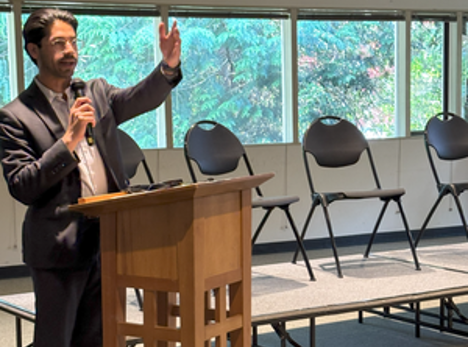
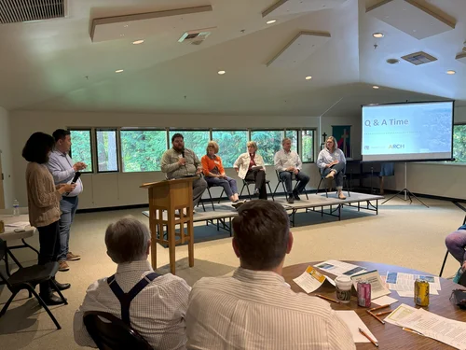
HR&A's Daniel Warwick joined Representative Osman Salahuddin and housing leaders from across the Eastside at a June 2025 convening hosted by Imagine Housing and ARCH, where faith leaders, developers, and elected officials gathered to discuss the role of faith-owned land in addressing the region's affordable housing crisis.
Looking Beyond Washington
The core lessons from HR&A's analysis are straightforward and replicable: cast eligibility criteria broadly to capture the widest share of faith-owned parcels, allow mixed-income development to reduce dependence on competitive federal funding, and ensure faith communities have dedicated support throughout the process. Where those conditions are in place, faith-owned land can be a meaningful and largely untapped source of affordable housing in communities across the country.
- Develop financing sources to support mixed-income development
- Legalize density bonus for mixed-income developments
- Expand subordinate grants and loans for LIHTC projects
- Support creative deal structuring
- Update and/or codify density bonuses in a manner that reflects needs of each community
- Implement flexible design standards
- Reduce parking requirements
- Establish accelerated approvals
- Expand the framework beyond faith-based land
- Facilitate dialogue with congregations based on community needs and priorities
- Address the pre-development needs of faith-based owners
- Pool resources and support for cohorts of faith-based organizations
Curious about the role faith-owned land could play in your community's housing market? Explore what HousingWeaver can do for you →, or get in touch with our team to learn more.